Telekin vs running an open-source memory server yourself
Yes, you can run Telekin's software yourself: Telekin runs on okf-mcp, which is open source under the AGPL-3.0 with every feature included. Running okf-mcp takes a server, a PostgreSQL database and someone to keep it updated and backed up. The hosted service does all of that for $8 a month, and works in web and phone apps from day one.
Is it the same software?
Yes. Telekin runs on okf-mcp, which is open source under the AGPL-3.0, with every feature included: drafts, history and undo on every note, and the checks that keep it tidy. Nothing is held back for the hosted service.
What does running it yourself take?
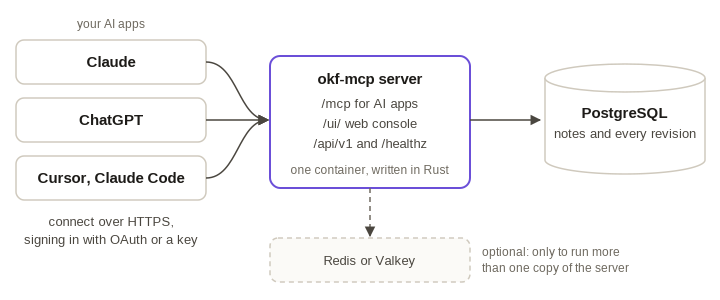
A server and a PostgreSQL database. okf-mcp is written in Rust and ships as a container image, or you can build it with cargo. It keeps your notes in the database, with every change saved as a new revision, so history and undo work just as they do on Telekin. It sets up the database itself when it starts.
It serves MCP, the web console and an API from one address. AI apps sign in with OAuth, or with keys you make, and only a hash of each key is stored. By default it runs as one copy; to run several, you add Redis or Valkey so they share sessions.
You'll also want a public address with HTTPS so web and phone apps can reach it, backups of the database, and someone to apply updates.
What does the hosted service add?
There's no server to run. Because it's hosted, it works in web and phone apps too, not just on the computer where you set it up.
Your memory is encrypted on the way between your AI app and Telekin, and encrypted at rest. Telekin staff can't open it without deliberately unlocking it and giving a reason, and every unlock is recorded in an audit log you can see. More on security.
Your console lists every app and key you have approved, with when each was last used, and you can revoke any of them. You can download your catalogs at any time.
Can I move between the two?
Yes, both ways. The console downloads your whole memory as a .tar.gz of Markdown files, and okf-mcp imports that same archive, so you can start on Telekin and move to your own server, or the other way round. An import followed by an export gives back the same files.
What does each cost?
okf-mcp is free; you pay for the server, the database and your time. Telekin Personal is $8 a month or $85 a year, after a 30-day free trial, and Team plans are $12 per seat per month, from 3 seats.
How do I connect apps to my own server?
The same way as to Telekin. Your server serves MCP at /mcp, and apps sign in with OAuth once you give it its public address, or with keys you make in its console. The Telekin connection guides work for both; use your own address instead of Telekin's.
How do I keep it running?
A new container image is published with each release, so updating is a matter of moving to the new version; the database is updated when it starts. The server has a health check at /healthz for your monitoring, and the repository has an operator guide with a Kubernetes example. Telemetry is off unless you turn it on.
Where does the hosted service keep my data?
In the United States: in AWS's Ohio region, with a disaster-recovery copy in AWS's Oregon region. Backups expire after 14 days, so anything you delete is gone from every backup within 14 days. If your plan ends, your memory is kept, unchanged, for 30 days so you can download it or renew, and then it's deleted.
Today only the founder can reach the servers, the database and the hosting account.
Is the hosted service end-to-end encrypted?
No. Telekin has to read your notes to search them and serve them to your AI apps, so the service itself can technically read them. Its controls make access deliberate and visible instead: every staff unlock needs a reason, is written to your audit log, and is emailed to you. If you need nobody but you to be able to read your memory, run it yourself.
When should I run it myself?
If you want your memory on your own machines and you're happy running a server, run okf-mcp yourself.
Questions
Is the open-source version missing features?
No. The hosted service and okf-mcp are the same software, with every feature included.
Can my team share a self-hosted server?
Yes. okf-mcp has teams: each catalog belongs to a team, and each person connects their own AIs with their own account, so every change is recorded under their name.
okf-mcp's details are from its README, as of November 24, 2026.
Start 30-day trial See pricing Ask us a question
Related comparisons
- Telekin vs Basic Memory: Both give your AIs one shared memory in plain Markdown, on open-source software. Telekin is a flat $8 a month; Basic Memory Cloud is $19 a month per workspace, billed in usage credits.
- Telekin vs an Obsidian vault as AI memory: Hooking an AI up to an Obsidian vault works on one computer. Telekin is hosted, keeps AI memory apart from your own notes, and tidies itself.
- Telekin vs Mem0: Mem0 is memory infrastructure for developers building AI apps. Telekin is a memory for people using AI apps: readable notes, at one flat $8 a month.